Merry Christmas
Happy new year to all! I hope and trust that all reading this blog had a truly wonderful and blessed Christmas and a exemplary New years. I don’t know about you but the older I get the more I seem to travel for Christmas. It used to be that Christmas was a truly magical time that seemed to not need prior planning or even effort. I would go to sleep on Christmas eve in the greatest of hope that Santa would drop down our chimney (the fact that we did not have a chimney never dampened my hopes), then I would awake and rush to my parents room to raise them from their slumber in the noisiest way I knew how. From there me and my family would go downstairs and throw open the living room door to see what was waiting for us. At this young naive age, it was my understanding that Christmas was just a time of relaxation and fun. We all got a little break, be that from work or school, and we just woke up on the big day for us all to recieve gifts. I do remember wondering when I was younger why my parents did not seem to get as much from Santa as me and my brother did, but came to the conclusion that Santa just was not as impressed with their behaviour over the year as he was with mine and my brothers. I dread to think what conclusion I came to when I saw that my Grandma and Grandad got nothing. This year however, I found myself so bored of Christmas before it even arrived. Since the start of November me and my wife Becky were searching through the stores, comparing online prices and probing people for information on what they wanted. Then there was the inevitable mad dash a week before Christmas as we rush through the shopping centre trying to find last minute gifts. When Christmas eve arrived we had to drive to Dudley to spend the holidays with Becky’s family. Luckily once we were there, the magic started to return. Becky’s mum is a lovely lady who seems determined to not let us lift a finger whilst we were in her company. She would make sure we had plenty of snacks, were well fed and always had a drink by our side. What topped all this off was when she brought through two large sacks of presents, one with Becky’s name on and one with mine on. I may no longer believe that Santa brings the presents, but it was a true blessing to see the generosity of Becky’s mum come to save the magic of the season. This of course only continued the next day as I got to see what my wife had gotten me (a Nintendo switch, which I am yet to put down for more than five minutes) and we went for Christmas dinner at Becky’s sisters. As enjoyable as it all was, I felt completely drained for the entire day. Christmas had wiped me out.
And a Happy New Year
Then there is New years eve and day. A holiday that never seemed to make much sense to me growing up, yet now I tend to look forward to this part of the Christmas season more than Christmas itself. There is no expectation for these two days. I don’t feel obliged to buy for anyone, and I don’t feel obliged get up in the morning at any specific time. This year we were very fortunate to have had friends of ours offer us their cottage in yorkshire over new years. It was perfect and the polar opposite to Christmas. We were in, what felt like, the middle of nowhere in the most idyllic area. We had a fire on every night and best of all, our phones had no signal, so we couldn’t talk to anyone even if we wanted to. Both parts of the Christmas break were very enjoyable and despite having wiped me out were of great enjoyment and a welcomed change from the hectic schedule for working for the Church (as enjoyable as it is). But as they say, all good things come to an end. It’s almost quite a shock when the 2nd January comes around, like someone has just ripped off a bandaid. You have been planning and looking forward to Christmas and the subsequent festivities and now, almost without warning, it’s all over. You have no choice but to go back to you regular routine and put the decorations away for another year. I am sure to some this is the cause of great happiness and joy, but for most in the western world this is the cause of a great deal of depression. It is often the way that people spend way too much on Christmas presents, food and drink, then January rolls around and they realise they are broke. They struggle to pay bills, they go into debt, they struggle to make ends meet all because they have been blinded by the bright lights of Christmas. To others it is not a depressing time because of finance, but rather simply because Christmas was a time of escape that they desperately needed and the thought of having to return to a state of routine and normality fills them with dread and sadness. These concerns are not helped by the weather getting colder and more difficult. The world can look quite dreary when it’s dark and the roads are covered in a black/grey kind of sludge. This is not restricted to just after Christmas (although it is more prominent), but it can be when coming back off any great high. When we come off holiday, when the summer draws to a close, when a relative bids you farewell to go back home. It can even occur after experiencing a great spiritual high. I remember when I first started looking into the Christian faith my Godparents took me to spring harvest and when they dropped me back off at home I could not have felt more down. I had come back off an incredible spiritual high and forced back into my normal life of routine.
Is all really Vanity?
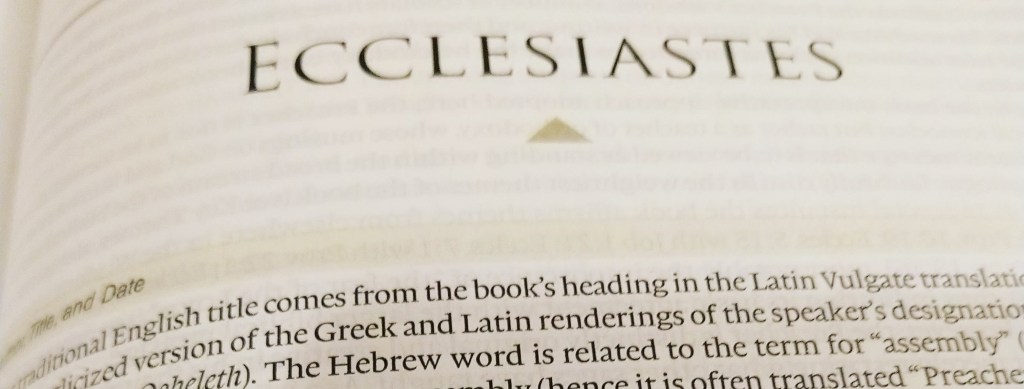
One of my favourite books in the Bible is the book of Ecclesiastes. It is one of the wisdom books and can be found in the Old Testament. If you are unfamiliar with this book then I advise you to find a Bible and give it a read, it is only twelve chapters long and will give you a lot to pontificate about. As one of the more openly philosophical books in the Bible, I find I lose myself in its chapters all the time. But to someone who has never read this book before, it can just read like someone has become very flustard and written all their woes into this book. The author appears to be in such a state that he is even contradicting himself. He is someone who is struggling with the difficulties of life and subsequently I think this is a brilliant book in the Bible to work through in one of the most depressing months of the year. As soon as you begin to read the book, the first 11 verses are the writer listing the vanities of this world. A strange phrase to begin with and equally a strange word to use. The word ‘vanity’ is notoriously difficult to translate, literally the word means ‘vapour’ and conjures up a picture of something fleeting, ephemeral and elusive. When applied to human undertakings or the pleasures and joys of life, as the author of the book of Ecclesiastes is clearly doing in the first chapter, it indicates that the present form of the world is passing away. In other words, the author of this book begins by simply listing how everything in life does not last, the second verse in the first chapter says, “vanity of vanities, says the preacher, vanity of vanities! All is vanity.” In this morbid frame of mind the author is asserting that all is fleeting, nothing lasts, nothing offers fulfilment and nothing will ever make you happy. Perhaps I am going out on a limb here, but I think we have all either been that person, or witnessed that person who is in such a mood or so upset that they begin to tell you that everything is hopeless. Before writing this blog I had a read through one of the Bible commentaries I own to see what it said about this particular book in the Bible, and one of the things it does is offer an outline to the book in the Bible that you are looking into. The title given for the first chapter of the book of Ecclesiastes is, ‘first catalogue of vanities’. You know life is difficult when you can sit down and fill more than one catalogue with everything you think is wrong and useless in your life at that moment. I think this is a state that people find themselves in at January after the wonder of Christmas has drawn to a close. I know when my brother is in a bad way, because when I talk to him he just tells me how rotten everything is, even if you mention the most wonderful things in the world he will be able to tell you what’s wrong with it. “Oh Zak isn’t it a lovely summer’s day?” “I hate summer, it makes me sweat and feel uncomfortable.” “Zak why don’t you buy some flowers for your girlfriend?” “What’s the point, they’re just going to die.” Zak is rarely in a mood such as that anymore, but I imagine if he had lived a couple of thousand years ago he could have written a few of his own catalogues of vanities. The author of this book seems to be in such a state that he even begins to contradict himself. For example in chapter 7 verse 12, wisdom apparently preserves life, but in chapter 2 verse 16 it does not. Death is preferable to life’s misery in chapter 4 verse 2, but life is superior to death in chapter 9 verse 4-6.
Who said all this and why?
Despite the fact that all of this sounds like a man who is losing his grip on reality and losing faith in life itself, that is not actually what is going on here. Despite the fact that this book is technically anonymous most Jewish/Christian scholars believe that this book was authored by Solomon. This is because in Ecclesiastes 1:1 it describes the preacher as the ‘son of David, king in Jerusalem’. Solomon was known for his wisdom and this book is actually a testament to that very point. The speakers designation indicates that he is addressing an assembly of some kind, though his counsel in chapter 5 verses 1-7 would seem to suggest a setting outside if the temple. The purpose of the book is acknowledged to be seeking to impart wisdom and knowledge to the people of God (see chapter 12 verses 9-11) and particularly looking at teaching them to fear the Lord. Now I have touched on this in previous blog entries but just in case you missed them, this does not mean ‘fear’ as you might think. Instead the original hebrew word might better be translated as ‘reverence’. Solomon is seeking to teach the people of God to revere the Lord. Now there is an element of fear involved here, but not the kind of fear associated with a bully or a killer. I fear disappointing my parents and my grandparents, because I respect them so much. In the same way I fear God. I fear not living up to His expectations. This is a crucial lesson for any Christian. When I read this book I think of the story of Descartes who coined the popular phrase, “I think, therefore I am.” The story of how he came to this phrase is through a great deal of reflection. As a philosopher he questioned everything. He began to question what in the world he could truly trust. Can he trust that meaning of the world is pleasure? No because like the author of Ecclesiastes he sees that all is vanity. Can he trust that he is not the only human in the world? No because he does not know if people think the same way he does, what if everyone around him simply does not exist (partly the source for the Matrix trilogy). He took his thinking to such an extreme that he decided the only thing he could believe with absolute certainty is that he is able to think these things, therefore he must be real. I sense a similar journey being told to us in this book, but rather than coming to a more introspective conclusion as Descartes did, the speaker comes to only see God as a certainty. God is our father, therefore He is the only way. Solomon is going through all the things that people seek to fill their lives with to offer it purpose and meaning, wisdom, knowledge, pleasure, possessions, accomplishments and even life itself. This is why there are contradictions in my opinion. In one vain wisdom preserves life, if you have wisdom of the holy scriptures and wisdom of God then yes it will preserve life. If your wisdom is of the world then it will not, it is a vanity, like vapour it is fleeting. When it is said that death is preferable to life’s misery well this is not really the first time someone has had that thought. Socrates, one of the greatest philosophers in all of history came to the conclusion after all his thinking that death was indeed preferable to death. Dostoevsky, another great philosopher, believed that without a belief in God then there will be no true meaning to life. Solomon (who I believe lived after Socrates and before Dostoevsky) has also come to this conclusion. In contrast to this, if you live for God then you will find true meaning. Philosophers all across history have come to this conclusion, even Jordan Peterson (a man who does not truly believe in God) believes that the only truly moral and meaningful way to live, is to live as if God existed.
Conclusion
So the conclusion to all of this is that things of the world will not bring us true happiness, all those delightful presents we received not long ago for Christmas will not bring us true happiness. True meaning, happiness and fulfilment come from God alone. If you are feeling somewhat lost this January, somewhat empty and run down, then I urge you to seek God, read His word, pray without ceasing and find others to pray for and with you. The same applies to you for when you are coming off a spiritual high. There is nothing wrong with going through a wonderful time where you feel on top of the world and closer to God, but there will always be times where that fades, or we struggle. That does not make you a bad Christian, it makes you human. If Christmas was a much needed break for you and you are saddened by the idea of returning to a state of normality, then you need to remember that with God, there is not state of normality. We worship an exceptional God and you must remember that He has an exceptional plan for you. We only need to realise it. But in the words of Solomon, “the end of the matter; all has been heard. Fear God and keep his commandments, for this is the whole duty of man.
 Where There’s Blayze
Leave a comment