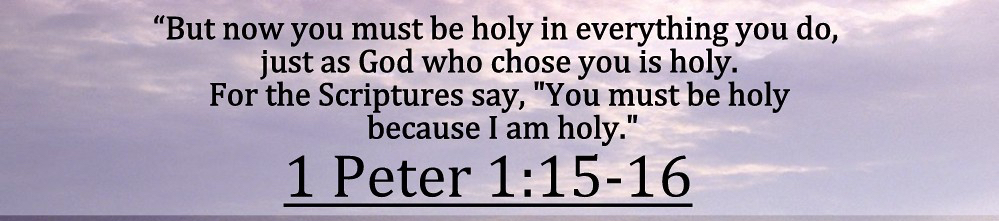
The importance of Spiritual Holiness
The mere mentioning of ‘Holiness’ will spark a variety of thoughts in people’s minds with both positive and negative connotations. For some Holiness is what they strive to achieve, this endless endeavor to better oneself to the extent where their attitude will be so in line with biblical teaching that others would look upon their lifestyle and describe them as having a holy life. For others there is too much baggage attached to this term and it summons too many negative implications to mind. The phrase ‘holier than thou’ springs to mind, this attitude that someone thinks they are better than everyone else and subsequently becomes a judgmental character determined to show how they are better than everyone else. I imagine that even as you read this you yourself feel drawn to one experience more than another, I know I do. Despite all this we as Christians are called to live a life of holiness.
Methodism and Holiness
For Methodists this notion of Spiritual Holiness is quintessential as it is so engrained in their denomination’s history. The founder of the Methodist movement, John Wesley, famously attended a meeting in Aldersgate, London on the 24th May 1738 and encountered the Holy Spirit in a powerful way. It was at this time that John Wesley was feeling somewhat defeated as he had come back from America having in many ways embarrassed himself in his ministry and not lived up to the standard he deemed necessary for a man in his position. Yet after this meeting and encounter with the Holy Spirit John Wesley wrote in his journal, “I felt my heart strangely warmed. I felt I did trust in Christ, Christ alone for salvation; and an assurance was given me that He had taken away my sins, even mine, and saved me from the law of sin and death.” It was after this that Wesley began to come to cement his theology of ‘Christian perfection.’ A controversial title, but this belief was that perfection for any Christian was when they so fully believed that Christ had died for their sins personally and appreciated the power that even when they did sin it had no bearing on them. They knew the love of Christ and felt His Spirit so emphatically that even when they found themselves falling short, they would give that over to God and not let it have any power in their lives. To me this is an essential lesson for all Christians to learn. I have found that when I personally fall short I tend to enter into a spiralling mentality. Like a child embarrassed by his mistake the last thing I want is to confront my father but rather avoid that eventuality. It’s that mentality of burying your head in the sand that only leads you to continue to sin. You are refusing to come before God and allowing his Spirit to sanctify you, so you inevitably continue to go astray.
I like to compare this experience to cheating on a diet. I could go months of healthy eating and maintaining a routine of exercise, yet inevitably one day I cheat on that diet and eat everything I shouldn’t. The healthy thing to do in that situation is acknowledge that I was not right to do so and to go straight back to my routine of diet and exercise, but instead I find myself entering the ‘one more wouldn’t hurt’ mentality. So I broke my diet, might as well make the most of it. This naturally means I stop exercising as well as that would force me to appreciate that I should stop gorging on all my unhealthy treats. After a while I find it so difficult to get back into my routine of healthy eating and exercise. I am out of habit, what started as one night of unhealthy eating has turned into a whole week of gorging on all things greasy and sweet. It is that same spiralling process that seems to grab me in my spiritual walk with God. Being able to constantly seek God and the Spirit of Holiness even in the face of our sins is, by Methodist terms, Christian perfection.
The Spirit of Holiness or of Sanctification
For some a better title would be the Spirit of Sanctification, a word that can be found littered across the New Testament. The term in essence means being washed and made clean by the Holy Spirit to a point of being made holy. The term may be much more frequent in the NT but that image of being made new is very present in the Old Testament such as in Isaiah 64:8. To me holiness is the end goal whereas sanctification is a continual washing process, a tap turned on that we continually come to cleansing us of our sins. This sort of imagery of being washed clean is the foundation of our doctrinal beliefs in the sacrament of Baptism and can be seen even in Christ’s baptism in Matthew 3:13-17. Even later in the New Testament we see Paul refer to this idea of the Spirit of Sanctification as water in his letter to the Ephesians in how Christ has made us holy and how in turn we must do likewise for our wives. In Ephesians 5:25-27 Paul writes, “Husbands, love your wives, just as Christ loved the church and gave himself up for her to make her holy, cleansing her by the washing with water through the word, and to present her to himself as a radiant church, without stain or wrinkle or any other blemish, but holy and blameless.” There we see the power of the Christ’s Holy Spirit making us holy by the cleansing and washing power of the Holy Spirit.
The Spirit that sparks a flame
If sanctification is cleansing us of our sins, then it is only preparing us for living a life of holiness, it is not actually moulding us into that desired holy lifestyle. This is where I find the Spirit of Holiness is so closely linked to the image of fire. Immediately the image of fire stirs up a more responsive attitude, where water can be seen as calming and cleansing, there is an urgency and a sense of refining associated with the image of fire. This is to me a testament to the refining power of the Holy Spirit, in Zechariah 13:9 it says, “And I will put this third into the fire, and refine them as one refines silver, and test them as gold is tested. They will call upon my name, and I will answer them. I will say, ‘They are my people’; and they will say, ‘The Lord is my God.” (see also Malachi 3:1-3) John Wesley’s theory of Christian perfection was widely criticised for its title as it led many to assume he meant that a Christian could be perfect, when in actuality it is only Christ who was perfect. But what he was saying is the holy living for a Christian is in its perfect state when we are constantly allowing this sanctification this purifying fire to cleanse us of our sins. This is a continual effort that is never fully complete while we live in a sinful world and are constricted by our mortal forms. Despite the notion that there is no end game in this life, continually allowing the Holy Spirit to work in us and change us is what will ultimately lead us to growing in holiness. This is why Jesus promised the coming of His Spirit, it was so that we may be made holy. In Matthew 3:11 John the Baptist prophesies this by saying, “I baptize you with water for repentance, but he who is coming after me is mightier than I, whose sandals I am not worthy to carry. He will baptize you with the Holy Spirit and fire.” As I understand it, Baptism is a declaration we make as we are cleansed of our sins, but it is the baptism by the Holy Spirit that will ultimately change us and make us Holy.
Signs will follow
If you are reading this and have been a Christian for a great many years then I am positive you could reflect on who you were when you chose to follow Jesus and see that you have changed. I was looking over some of my old books last week in an effort to organise my bookshelf and I came across a book that was given to me when I became a member of the Methodist Church. I remember thinking on that day that even though I had been going to Church for a few years by this point I had only really welcomed Jesus into my life in the last year, less than that really. It shocked me to open the book and see the date as being July 2013. That is just over six years ago. I take great comfort in knowing that I have only been a Christian for a little over six years, because I think of who I was before I gave my life to Christ and who I am now and I have become a doppelganger of my former self. Ultimately, we share little more than a vague resemblance of each other, everything else fundamentally has changed. My beliefs, my morality, my actions and my priorities have all changed drastically. When I go back to Lincoln where I spent my teenage years I often bump into old friends and it’s something I greatly enjoy, but I always hear them tell stories of when we were younger, and I shudder. What was once condonable and even enjoyable seven years ago was now something I saw as immoral, unjustified and sometimes I would be filled with shame as I listened to them. I am by no means a perfect human at my current state and I am positive I still do a great many things that are wrong, but I am comforted by the fact that over the space of seven years I have changed, for the better, I have become more Christ like. Don’t get me wrong, I am a long way away from the lofty standard set by Jesus but day by day, year by year I understand the Bible that little bit more, I experience something new of God and with each new lesson and each new experience I am transformed by the power of the Holy Spirit.
This kind of transformation should be expected and is a testament to the redeeming power of Jesus in our lives. If we profess to the world that we have the Spirit of God within us and they see no real transformation, then is that really true? In James 2:17 James writes, “So also faith by itself, if it does not have works, is dead.” It is kind of like cause and effect, you experience the Holy spirit, which is the cause, and then your life changes bit by bit, this is the effect. If the cause is not there, we shall see not effect. For Paul walking on the road to Damascus, had he not witnessed the power of the Holy Spirit, we would not have seen him change his life to help the early Church flourish (Acts 9). Without a cause we can have no effect, but equally without the effect we must question what the cause really was. I am not saying that if you are not completely perfect immediately after and encounter with the Holy Spirit then it never happened, but if someone can see no change in thier life afterwards then we must question if what they experienced was all that great or if the sanctifying effect of the Spirit is truly at work. I listen to some Christian rap and there is a rapper called KB and there I a line from one of his songs that I absolutely love. “I have seen the Lord the same I will never be, some say they have seen the Lord but live all casually. I don’t know what you saw, but the Lord aint what you’ve seen, once you’ve really seen the Lord your obsessed with what you have seen.” Think of Paul, the disciples, or Moses. Once they had encountered the living God their lives changed, they were obsessed. They still made mistakes, Peter denied Christ, Moses defied God. It does not make us perfect, but it does change us. This to me is what James was referring to in the book of James 2:17 that we mentioned earlier, he uses harsh words but they are completely true. Our works are a testament to what the Holy Spirit is doing within us. It is a process that takes time but it is a process that ultimately reflects who we are and who we represent. We are told in 2 Corinthians 5:20 that we are ambassadors for Christ, this means when people look at us they should be able to see more than our mortal selves, they should see Christ in us.
Where does our change originate
In Luke 6:43-45 Jesus tells us that our true selves come from our heart. Our truest selves originate in our heart, in other words who we are is a result of what is pouring out of our very core. So, if the power of the Holy Spirit is to change us and impact on us, it will start from our hearts. This ties in with the experience of John Wesley at Aldersgate when he mentioned his heart being strangely warmed. John Wesley is also an example of how his works changed after this encounter with the Holy Spirit. The night he went to Aldersgate his journal tells us that he was feeling quite defeated and frankly he had every reason to. He had gone over to America having been confronted with a group whose faith was far greater than his own and then once in America he struggled to make any real change. He wrestled with his faith and refused a woman he had a crush on to take communion because she was marrying someone else. This is a far from perfect ministry, but it was after his encounter at Aldersgate that he truly began the Methodist movement and ultimately the first great revival of this country. He was changed by the Spirit of holiness and from there he went on do great works. He received the Holy Spirit, the cause, and then brought about revival, the effect.
We must let the Holy Spirit in to touch our hearts otherwise the fruit we produce will not be of God but of the world. In Luke 6:45 it says, “the good person out of the good treasure of his heart produces good, and the evil person out of his evil treasure produces evil, for out of the abundance of the heart his mouth speaks.” If I could be so black and white for a moment, the words we speak will either bless or they will curse, they will either have a positive effect or a negative one. If I were to write a blog about my family and then insult my dad for the first few pages you would not look to me as an ambassador of Christ, or not a very good one at any rate as I have already broken the fifth commandment (Exodus 20:12). You would see that what is flowing out of my heart is not good but evil. Words are hugely important, God used words to create this planet in Genesis 1, Peter converted three thousand with his words in Acts 2:41. The words we speak are a result of our heart, of our core. If we have been changed from within we should not tear down but build up. In Ephesians 4:29 Paul says, “let no corrupting words come out of your mouths.” This is important because to exercise the power of the Holy Spirit we pray; we use our words. When people ask to receive prayer, others will speak over them. We must be very careful with how we use our words as people will judge our faith by the example our words make. I am always very disheartened when I hear people talking about politics, especially in regard to Brexit. Even when I am in a Church, I will hear people mocking our politicians, insulting them and harbouring anger towards them. What example does that set to the rest of the world when the Bible tells us to pray for our world leaders (1 Timothy 2:1-7). This command was given to the early Church at the time when their world leaders were persecuting them and killing them. When the early Church sought advice on what to do, whether to rise up and meet violence with violence Paul responded by saying we should instead show love and pray for them. If as a Church we simply showed love to our world leaders such as Corbyn, Johnson, Sturgeon, Trump, Macron and all others we would already seem so different. Part of living a life of holiness is allowing yourself to be different in showing love in a time when others are simply showing anger and division and we must use our words to do so.
what to do with all this
If you have managed to read all of this then you first of all have my gratitude and even my respect. This was intended to be a short bit of writing, but as you can no doubt see, I got quite excited and caught up in the topic. We all have the opportunity to be holy, it is not boasting, it is accepting that we are flawed but that we want to be continually getting better. I invite you to pray for the Spirit of holiness to wash over you, convict and mould you. After that it is your job to go out and share that Spirit with others, in Matthew 28:19, “Go therefore and make disciples of all nations, baptizing them in the name of the Father and of the Son and of the Holy Spirit.” If You have received the cause, then now be the effect on others. You might not be perfect, but what you are speaking over yourself and others, that is perfect. That is the Spirit and the life of holiness, to let that perfect power change you from your core and transform you and those around you.
 Where There’s Blayze
Leave a comment