
In my circuit we have a minister who is also in charge of ‘digital evangelism.’ It’s a role that is increasingly essential within the Church as most individuals in Britain have a digital personification of themselves. An internet avatar present for all to see and engage with on social media and YouTube. Especially after the Covid-19 pandemic when the population was subject to draconian restrictions that forced many individuals to confront their technological illiteracy in favour of the only available avenue for social interaction. It is without a doubt an arena the Church needs to be increasingly present within. It is perhaps then not surprising that many individuals have not gone back to their churches in favour of attending an online church, or watching a service on facebook or YouTube. I enjoy following the various things that this minister posts on the circuit Facebook page. Partly for the content itself, but also to observe the reactions to them. The various comments, or perhaps more importantly, how many people engage with it. If people do not engage with a particular post, then that is perhaps an indication that it is not a subject that interests people greatly. Not enough to engage with it anyway. But it is also interesting based on the reality that individuals tend to be more open and blunt on social media as they are protected from having to navigate potential awkwardness or confrontation that may come from face to face discussion. This certainly has its negatives, but also its positives. Social media becomes an excellent platform to truly engage with individuals honest opinions without having to sift through peoples comments to find the underlying truth.
The latest project of our digital evangelist is to post every day of December up until Christmas with individuals thoughts on ‘what does Christmas mean to you?’ I hesitated to respond, partly out of curiosity to see what others would write first, but mostly because I didn’t really know how to answer that question. After the first few days I saw a re-occurring theme establish itself in peoples responses. Much of what Christmas seemed to mean to people was dictated by a nostalgia. There’s nothing wrong with this but it seemed to set a difficult standard for future Christmas’ to live up to. The answers were littered with examples of gift giving, excessive food and family gatherings. As a Christian page most posts (not all) mentioned the birth of Jesus as as the root of the holiday, but the message of the birth of Jesus seemed almost insufficient as an answer on its own. As if it were to neglect the reality of what Christmas really is today. This has often been a point of reflection for me. Being brought up in a non-churched family, my nostalgia of Christmas is divorced from any conscious understanding of Jesus. While I may have been aware of the significance the Church placed on the season, it was never something that my family really recognised when I was growing up. The magic of the season was the torturous waiting to see what presents were under the tree, the long break from school that promised to be action packed with seeing family and friends. The prospect of our home being stocked full with our favourite soft drinks, chocolates, food and snacks. Once I became a Christian, it seemed difficult to marry this perception of the holiday with its supposedly true ethos.
Some of my nostalgia will naturally fade with time. My dedicated belief in Santa coming to my house to drop off presents was shattered when I found my mum and dad hiding the presents behind our sofa. My fondness for the long break over Christmas lessened the more I moved into work that I both enjoyed and found fulfilment in. In an ironic twist, I have often found myself excited by the prospect of January when I can go back to my work within the Church. Seeing family is still a magical prospect, but it can never be what it was. As children we are not privy to what goes on behind the scenes. The difficulties of acting as host to so many people, the effort required to try and balance everyone’s interest in the hope of maintaining harmony in pursuit of that perfect Christmas. As a child, you are not involved in such things. Blissfully ignorant, as well you should be. Gifts lose their allure when you are faced with the stark reality of the cost they incur and the limited life they will have. Don’t get me wrong I still deeply appreciate it when anyone buys me a gift, and I adore giving to others, but it is now also a source of stress as we approach December and I have to think carefully on how much I can realistically spend on people. If I were to truly try to live up to the nostalgia of the Christmas of my younger years I would need to receive something that greatly excites me, and potentially something I don’t think I will get. Today there is no comparative item. Other than some vastly expensive item that would truly surprise me to see under my tree. The older you get the more expensive the things you want seem to become. This is because as you get older, you realise that if you want something, and it is not too much money, then you will simply buy it. The only things we look at, desire and don’t buy, tend to be items that we simply cannot afford. As a child without an income, everything was more than I could afford. Being older I realise more and more that I don’t need things, and don’t really want others to have to buy expensive items for me, but it is an example of how unattainable the recreation of my former Christmas’ truly is. To some degree, Christmas as I got older had simply become another day in the year for me. But with the birth of my two children some of the original excitement of Christmas has returned. I do find myself greatly looking forward to seeing them open their presents on Christmas day and share the season with others.
Being a Methodist Minister now, my children are inevitably to grow up with a vastly different experience of Christmas than I did. Chances are their dad will be working every Christmas Day. The traditions of the season will be inherently linked with Church services, carols and the Bible story that is the basis of this holiday. As impossible as it may be, I want to try and foster a longer lasting form of magic around the Christmas season for them that will stand the test of time in a way that mine has not. My original thoughts centred around the idea that I could raise my kids to see the wonder that is God taking on human form and coming to the Earth. Cementing the knowledge that this is the most exciting aspect of Christmas that we can engage with and it is a truth that we can live in every day of they year. But how practical is this? How much of the Christian roots of the season are still present in contemporary Christmas? How much are we still trying desperately to offer a Christian message into a season that no longer welcomes it? Does the winter months really need us to celebrate the birth of Jesus?
Realistically Jesus being born is not what makes us Christian, I would argue. What defines us as Christians is out belief that he died for our sins and was raised to new life on the third day. If we take away the parts of the Gospels that tell us about the birth of Jesus, then we lose important bits of information that we are blessed to have, but our faith and conviction remains intact. If we lose the parts of the Gospels that reference the death and resurrection of Jesus then we lose the foundation on which we have built our entire belief system. What makes Christians different from Muslims and Jews (amongst many things) is the fact that we believe Jesus was the son of God who died for our sins and rose again. If we disagree with these fundamental beliefs then we are no longer Christian. The early Church seemingly understood this as there is no record in the early years of Christianity of them celebrating the birth of Jesus. But we can see that the early Church did celebrate Easter. [1] Our long standing tradition of celebrating the birth of Jesus is realistically an appropriation of older traditions that sought to focus on stories of light in a time of year when things were becoming darker. Centuries before Jesus walked the Earth European nations light and birth in the dark, potentially bleak, midwinter. [2] An example of this can be seen from the Romans faith in the god Mithra, the god of the unconquerable sun. Mithra was believed to be an infant god and the Roman people would celebrate this deities birth on the 25th December. With the rise of Christianity and the fall of the Roman Empire, we gain an idea of how the Christian tradition replaced Roman mythology with its own narrative. It is after all a good fit. Jesus proclaims himself as the “light of the world” (John 8:12), why wouldn’t we focus on that light in a time when darkness is on the rise. The Roman tradition of belief in Mithra is a clear indication that a greater light in the world it is a timeless message that people sorely need to have hope in.
But this appropriation of the 25th of December for the message of Jesus’ birth was born out of the desire to reflect the faith of the majority within the nation. Britain, for example, has long been a Christian nation and so it makes sense that in focussing on His light in the darkest times of the year. Giving gifts and an emphasis on family is foundational within the Christmas narrative in the Gospels and we can see how society have adopted these elements even beyond Church practice. But as the 2021 census demonstrates, we are no longer a majority faith.[3] Have these customs of gift giving and family gathering eclipsed the Christian message that once underpinned it? There is certainly evidence to suggest this is the case. Yougov asked 1,874 individuals about whether they celebrated Christmas in a secular way or in a religious way, and this was the result;
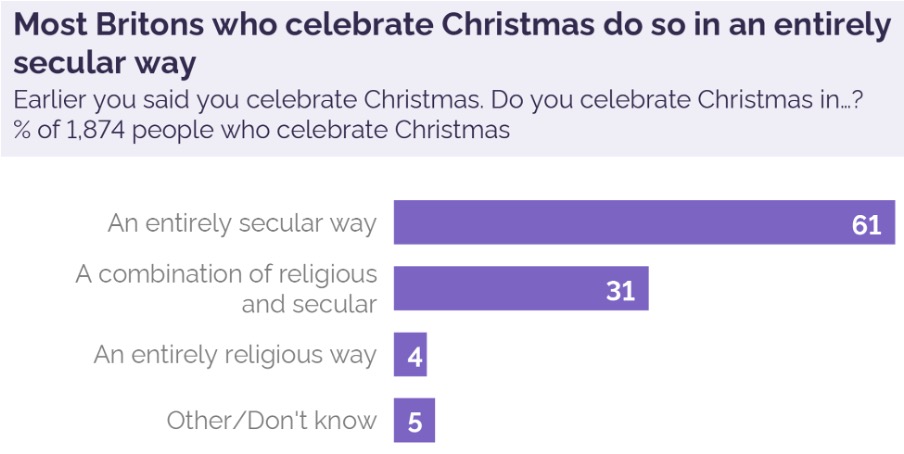
[4] As we can see, the majority mentioned that they celebrate the Christmas season in an entirely secular way. When we contrast this with the abysmal 4% who celebrate it in an entirely religious way, it is a stark contrast. Now this could be for a number of reasons. How does one celebrate the season in an entirely secular way? Do you refuse to sing any carols? Do you refuse to engage with any display of the nativity? And how do you celebrate it in a purely religious way? Must you engage in an advent Bible study, watch the popular Christian series ‘the chosen’ rather than ‘Home alone’? There is some wiggle room then in how we interpret this graph, but it is irrefutable that a strong majority felt confident in declaring that they celebrate Christmas, completely separate from the religious undertones that once defined the season. It may appear that I have opted to produce an entirely pessimistic blog for Christmas this year that seeks only to reiterate our decline, but honestly this might be an incredible opportunity. Now that Christianity is no longer a majority, and many in Britain have moved to a more secular understanding of the season, it gives us the freedom to be more unapologetic in our practice as the Church. An opportunity to recenter ourselves on the heart of the Christmas narrative as it if found in the Gospels, rather than on the traditions that have come out of it. To some degree, we are already doing it. The Methodist church at the moment is pushing an initiative called, ‘there is room.’ It is an advent liturgy that proclaims that we have room in our Churches for all. It is a call to all Methodist buildings to open their doors as ‘warm spaces’ for those in our community who cannot afford to heat their homes. This may not live up to my nostalgic understanding of Christmas, but it does warm my soul to think that this is such an honest and true practice to reflect the heart of the season and the Christmas narrative. When darkness surrounds us with colder days, and a cost of living crisis restricts many from mounting a defence against this reality, churches across the country open their doors as a light in the darkness. Offering hope in dark times. That is something I am proud to be a part of. That is something I would be happy for my children to think of when it comes to Christmas.
So if you are reading this blog and are in fact a Christian. Perhaps this year think of what it means to celebrate this season in a religious manner. How can you work to bring light into these dark times in the name of Jesus. If you are reading this blog and do not identify as religious (Bless you for reading through my waffle!), I truly hope you have a phenomenal Christmas! But do remember that even if you avoid the idea of the Christmas being linked to the birth of Jesus, remember that it is also a time of hope. A time of comfort for those for whom the darkness creates a season not of joy, but of fear and isolation. We may place our hopes in different things, but we should all be seeking to bring a little light into peoples lives this Christmas.
Merry Christmas everyone.
[1] https://expandedramblings.com/index.php/10-things-you-didnt-know-about-christmas/, Accessed 09/12/2022
[2] https://www.history.com/topics/christmas/history-of-christmas#how-did-christmas-start, Accessed 09/12/2022
[3]https://www.ons.gov.uk/peoplepopulationandcommunity/culturalidentity/religion/bulletins/religionenglandandwales/census2021, Accessed 11/12/2022
[4] https://yougov.co.uk/topics/society/articles-reports/2020/12/29/how-britons-celebrate-christmas-and-easter, Accessed 09/12/2022

 Where There’s Blayze
Leave a comment