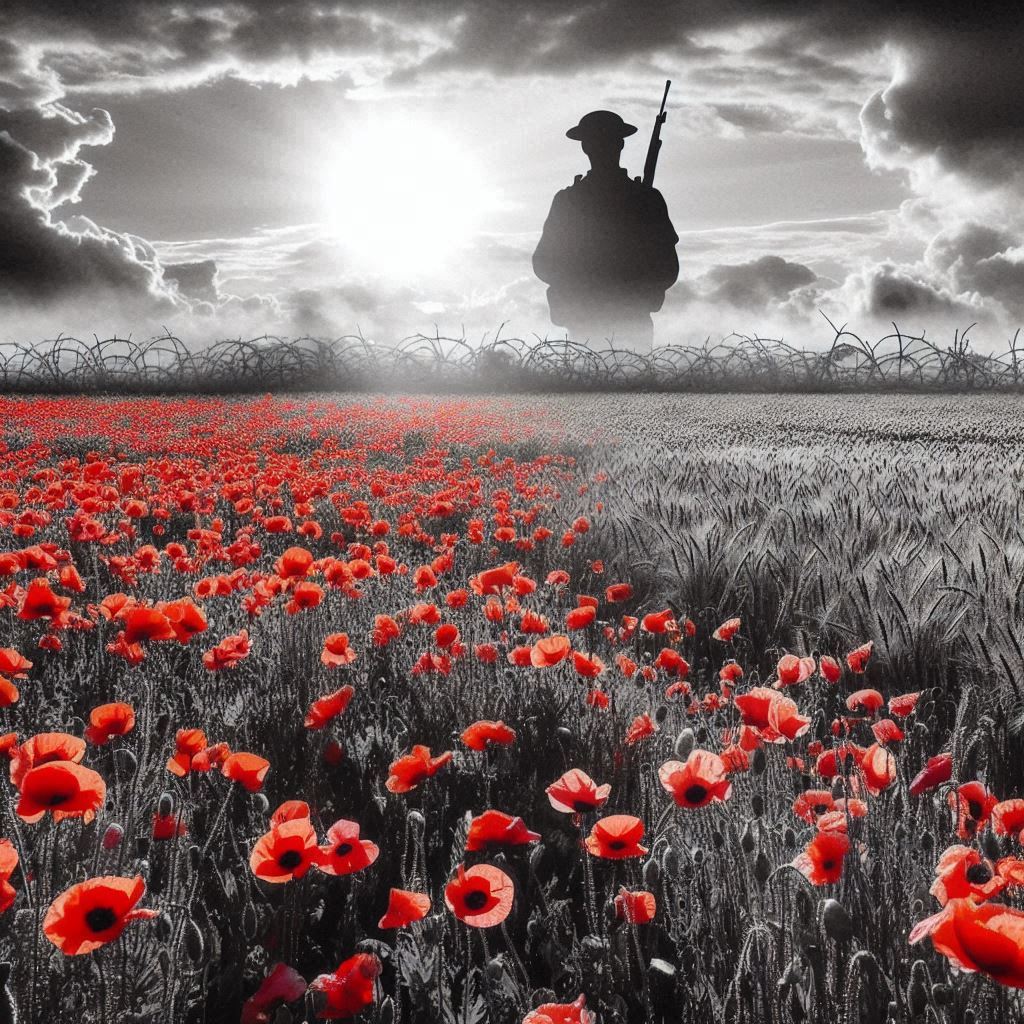
Every Remembrance Sunday, we gather to honour the courage and sacrifice of those who served and to reflect on the weight of war. It’s a day when words can feel insufficient, where we struggle with how best to honour the memory of those who gave everything. Should we speak words of hope? Should we offer warnings drawn from the shadows of history? One phrase lingers in my mind this year: Lest we forget.
“Lest we forget” comes from Recessional, a poem by Rudyard Kipling. Written in 1897, Kipling’s refrain wasn’t initially about war, but a caution against pride and complacency, a reminder to be humble before God. Kipling saw the rise and fall of nations as a cycle of human frailty. How true that phrase feels today when we remember wars and conflicts that brought such suffering and sorrow. Kipling’s call to humility feels timeless: a warning that we must never allow the lessons of history or the cost of war to fade from memory.
But what does Lest we forget mean for those of us who didn’t experience these wars? We weren’t there. Most of us didn’t see the horror of trench warfare in World War I, nor live through the Blitz or liberation of concentration camps in World War II. Yet, we can catch a glimpse through the words of those who did. I think of Captain George Montgomery of the 82nd Airborne, who wrote, “I just can’t believe it is all really happening. I never in my wildest dreams knew such terror could grip your very soul.” And the Holocaust, where 6 million Jews were killed, an atrocity that defies comprehension. How could such darkness take hold? History asks us to remember these events not as distant echoes, but as reminders of what happens when hatred and division go unchecked.
Today, we see the relevance of Lest we forget anew. The phrase appears in memorials and ceremonies each year, but is our remembrance as meaningful as it should be? Recent years have shown a troubling resurgence of antisemitism and divisive violence. The ADL’s reports reveal a surge in incidents against Jewish communities in the U.S., while the CST has documented record numbers of attacks in the UK. These trends are a grim reminder that hatred, though dormant, can re-emerge if we allow ourselves to forget. Lest we forget isn’t just about remembering the past; it’s a reminder to guard against these forces today.
Throughout Scripture, we see God calling His people to remember and to seek peace. Psalm 23 reminds us, “Though I walk through the valley of the shadow of death, I will fear no evil, for You are with me.” God’s presence brings comfort, even in dark times, but this psalm also challenges us to be people who seek light and peace. In the Sermon on the Mount, Jesus said, “Blessed are the peacemakers, for they will be called children of God” (Matthew 5:9). Being a peacemaker is a calling, a charge to actively pursue a world that reflects God’s love, even when it’s difficult.
The Bible also gives us stories of remembrance and forgetting. The books of Kings and Chronicles show a cycle in Israel’s history: war and peace, forgetting and remembering, straying from God and then returning. It’s a testament to how easily humanity forgets. Yet each time, God called His people back, back to remembrance, back to peace. Today, Remembrance Sunday challenges us in a similar way. It’s not enough to remember sacrifice in ceremony alone; we must live in a way that honours it. That means standing against hate and division wherever we see it. It means holding onto God’s calling to be peacemakers and letting that guide our actions.
So, let us truly take Lest we forget to heart. Let it be more than a phrase, more than a tradition. Let it be a call to live differently, to honour those who sacrificed by working to build a world where peace and unity prevail. As we remember, may we be moved to live lives that reflect the love of Christ, the Prince of Peace, who showed us that true strength is found not in hate, but in love and reconciliation.
I end this blog with the words of the poem Recessional by Rudyard Kipling. In the hope that they may inspire, challenge and remain with us as they have done for generations;
God of our fathers, known of old—
Lord of our far-flung battle-line—
Beneath whose awful Hand we hold
Dominion over palm and pine—
Lord God of Hosts, be with us yet,
Lest we forget—lest we forget!
The tumult and the shouting dies;
The Captains and the Kings depart:
Still stands Thine ancient sacrifice,
An humble and a contrite heart.
Lord God of Hosts, be with us yet,
Lest we forget—lest we forget!
Far-called, our navies melt away;
On dune and headland sinks the fire:
Lo, all our pomp of yesterday
Is one with Nineveh and Tyre!
Judge of the Nations, spare us yet,
Lest we forget—lest we forget!
If, drunk with sight of power, we loose
Wild tongues that have not Thee in awe—
Such boastings as the Gentiles use,
Or lesser breeds without the Law—
Lord God of Hosts, be with us yet,
Lest we forget—lest we forget!
For heathen heart that puts her trust
In reeking tube and iron shard—
All valiant dust that builds on dust,
And guarding, calls not Thee to guard,
For frantic boast and foolish word—
Thy mercy on Thy People, Lord!
 Where There’s Blayze
Leave a comment