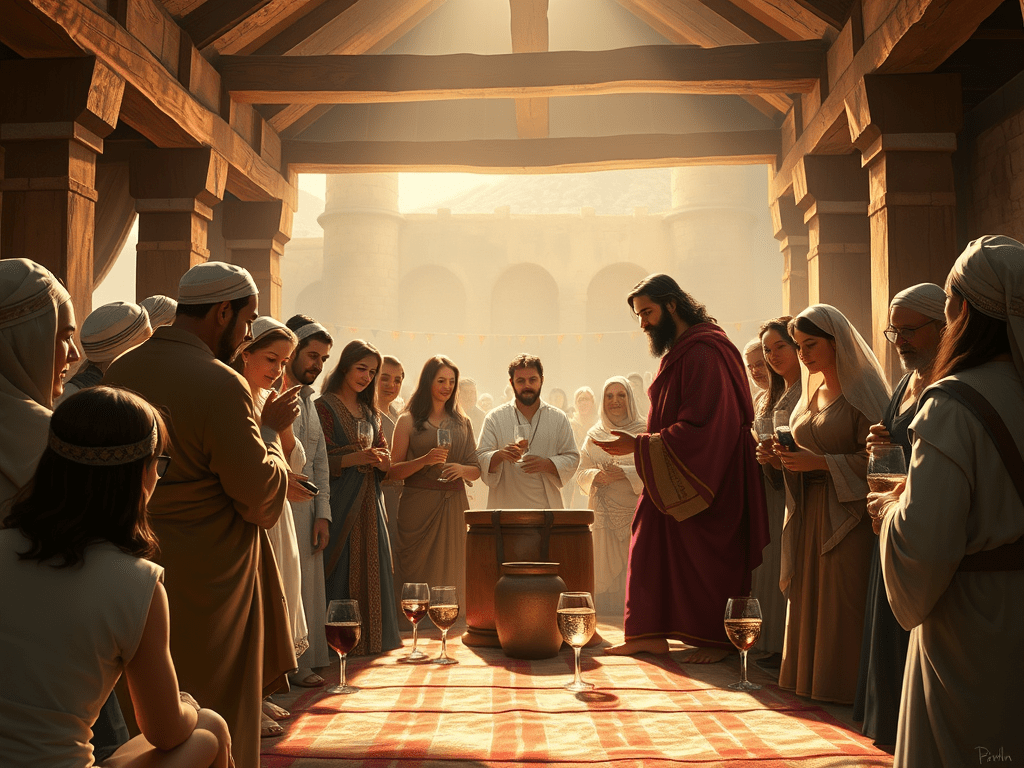
Let’s talk about the wedding at Cana. You know the story, Jesus’ first miracle. Water into wine. A great crowd-pleaser. But if we just take a moment to marvel at how strange this is as a debut miracle is it raises many questions. I mean, Jesus is the Son of God, the Messiah, here to save humanity, defeat sin, conquer death, and His first move is… to keep the party going? That’s His big opening? Water into wine. It’s like the divine equivalent of pulling a rabbit out of a hat. “Ladies and gentlemen, introducing the Messiah! He’ll be here all week.
Let’s face it: it’s not what we expect. God becomes man, steps into human history, and His first miracle is making sure everyone’s glasses are full. You’d think the first act of the Saviour of the world might be a bit more, well, dramatic. Maybe parting a sea or raising someone from the dead. But no, Jesus starts His ministry by ensuring the wine doesn’t run out at a wedding. It’s brilliant, baffling, and deeply human all at once.
What makes this even more intriguing is that Jesus Himself seems to hesitate. His mum, Mary, comes to Him with the problem: “They’ve run out of wine.” His response? “What’s that got to do with me? My hour hasn’t come yet.” (Translation: “This isn’t my problem.”) And yet, the next thing we know, He’s telling the servants to fill the jars with water. Despite His initial reluctance, He steps in. Why? Clearly, there’s more going on here than meets the eye.
Weddings That Last a Week
To understand what’s happening, you need to know a bit about first-century Jewish weddings. These weren’t just afternoon affairs with a buffet and a DJ. Weddings were major social events, often lasting an entire week. Seven days of feasting, dancing, and hosting everyone you’ve ever met. Suddenly, running out of wine seems less like an oversight and more like an inevitability. I mean, at my own wedding, if we’d gone on for a week, I can think of a few relatives who would’ve drained the supply by day two. By day three, we’d be serving tap water, and by day four, people might’ve been rinsing out their cups for a refill.
Now, imagine the pressure. A week-long wedding. Your entire town invited. In a small village like Cana, you couldn’t just limit the guest list to immediate family and close friends. Everyone came, neighbours, distant relatives, travelling guests. If someone didn’t get an invite, you weren’t just risking a few hurt feelings; you were courting scandal.
And then there’s the cultural importance of hospitality. In Jewish tradition, hosting wasn’t just about providing food and drink, it was about honour. Running out of wine wasn’t just embarrassing; it was a failure to care for your guests. It could bring lasting shame on the family. So, when Mary says, “They have no wine,” she’s not just commenting on the catering. She’s pointing out that this family is on the brink of a social catastrophe. And that’s where Jesus steps in.
The Significance of Wine
But this miracle isn’t just about fixing a hospitality crisis. There’s something deeper at play. In Jewish tradition, wine was more than a drink. It symbolised joy, celebration, and God’s blessings. The Bible often uses wine as a metaphor for abundance and divine favour. Think of Amos 9:13, where the mountains “shall drip sweet wine,” or Psalm 104:15, where wine is said to “gladden the human heart.” To run out of wine wasn’t just a practical problem; it symbolised a loss of joy, a scarcity of blessing.
By turning water into wine, Jesus does more than save the day. He makes a profound statement about His mission. This miracle sets the tone for God’s relationship with His people. It shows us that the kingdom of God is a place of joy and abundance. It’s not about scarcity or judgment, it’s about restoration and life in all its fullness. Jesus takes what’s empty and fills it. He transforms what’s ordinary into something extraordinary.
A Foreshadowing of the New Covenant
There’s another layer to this story. Look at the jars Jesus uses. They weren’t just random containers, they were stone jars used for Jewish purification rites. They symbolised the old covenant, a system of rituals and laws designed to cleanse and prepare people for God. By turning the water in those jars into wine, Jesus is making a bold statement. He’s transforming the old covenant into something new. The wine points forward to His blood, the blood of the new covenant, which we remember in communion.
And here’s the thing: just as the communion table is open to everyone, so is the wine at Cana. Jesus doesn’t make a little wine, He makes around 120 to 180 gallons of it! That’s an abundance. It’s more than enough for everyone. His grace, His blessings, His joy, they aren’t limited. They overflow.
The Power of Transformation
But perhaps the most beautiful part of this story is its message about transformation. Jesus doesn’t bring in new wine; He takes what’s already there, ordinary water, and transforms it into something extraordinary. And that’s what He does with us. He doesn’t wait for us to be perfect or polished. He takes our ordinary, our emptiness, even our failures, and transforms them into something beautiful, something abundant.
So, as you reflect on this story, ask yourself: where in your life do you need transformation? What ordinary parts of you could Jesus turn into something extraordinary? Because just as He turned water into wine, He can take your life (exactly as it is) and make it overflow with His joy, His grace, and His abundance.
Let Him do it. You won’t believe the difference it makes.
 Where There’s Blayze
Leave a comment