You ever have a conversation where you’re sure everyone’s on the same page, only to find out later that the other person wasn’t even in the same book?
You’re like, “We talked. We agreed. There were words. Out loud.”
It’s especially wild when this happens with kids. My daughter Darcey just exited the “biting phase” (the toddler equivalent of Fight Club). I remember calmly telling her, “We don’t bite, okay?” She nodded like I’d just passed down divine wisdom.
Next day? Someone touched her toy and she went full piranha. I stepped in: “Darcey. We talked about this.”
She looked at me like, “I’ve never seen you before in my life, sir.”
She’s three. She has excuses. Adults? Not so much.
Let Me Tell You About the Holiday That Wasn’t
Second year at Bible college, Cliff College, I had a genius idea: lads summer holiday abroad. Three clear elements. Let’s break them down:
- Lads – Pure testosterone and terrible planning.
- Summer – Not winter. Not the emotional winter of heartbreak. Actual sun.
- Abroad – Beyond the United Kingdom.
So I pitch the idea to my best friend and flat mate. He agrees. All systems go.
A week later: “Any thoughts?”
He says, “My girlfriend has some suggestions.”
Excuse me, what happened to ‘lads’?
Another week: “Where to?”
He beams: “Nottingham!”
Friends. I said abroad. That’s not abroad. That’s a place you pass on the M1 and think, “Hmm, maybe next time.”
I asked, “What makes Nottingham the dream location?”
He said, “It’s romantic in the winter.”
Sir, I hope I am not the intended recipient of that romance.
Then he dropped the final blow: “We’ve invited another couple.”
So now it’s me. Two couples. In Nottingham. In winter. Watching The Holiday while sipping hot chocolate with passive aggression.
I asked, “Won’t I be the odd one out?”
He goes, “You’re right… maybe you shouldn’t come.”
I got uninvited from my own holiday.
People thought I made that up during his wedding speech. I wish I had. That was the most expensive non-trip I’ve ever taken.
Cue the Disciples, Who Also Didn’t Get the Memo
Sometimes people miss the plan. Sometimes it’s a holiday. Other times, it’s the resurrection of Jesus Christ.
Jesus told His disciples multiple times, “I’m going to die and rise again” (see Mark 8:31, Luke 9:22, Matthew 17:22-23). You’d think, after the third announcement, someone would think to speak up and say, “Remember: Jesus is coming back. Don’t panic.”
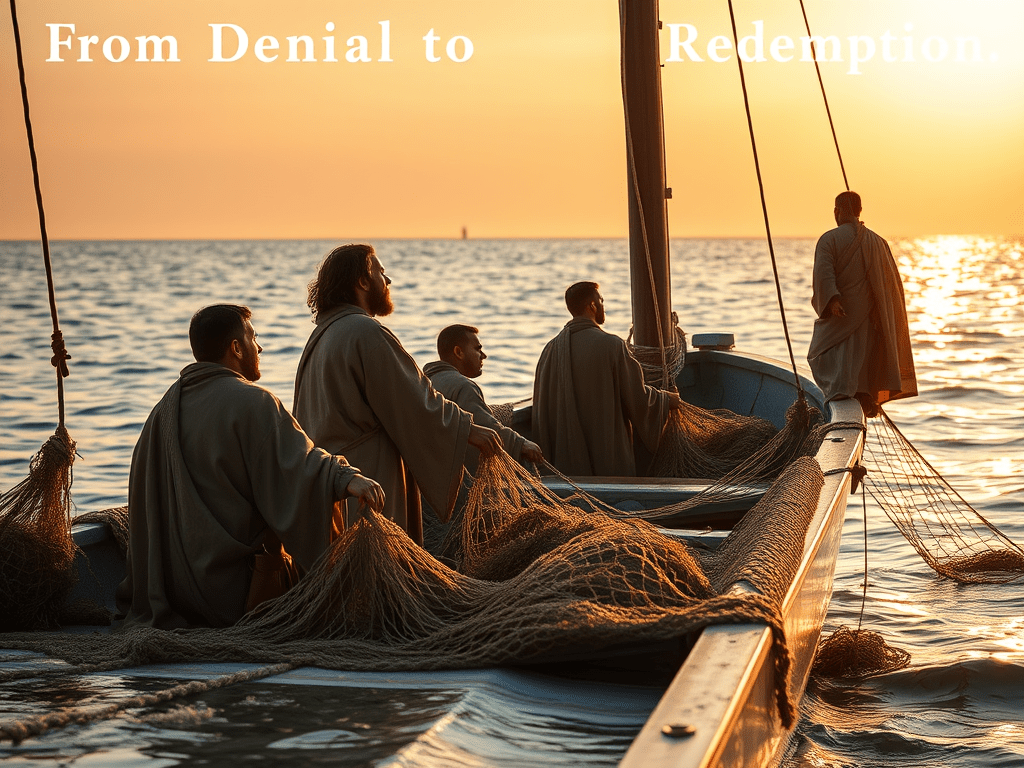
But when it happens? They’re hiding, fishing, pretending like Easter Sunday was just another weird weekend.
Enter John 21
Jesus is already resurrected. He’s appeared twice to the disciples (John 20:19, 26). Thomas had his doubting moment. But there’s still… tension. One disciple in particular has an awkward conversation to have with Jesus.
Peter.
The guy who promised, “Even if everyone else flakes, I never will” (Matthew 26:33). Then three denials later, he’s a one-man PR disaster.
Now, Jesus has appeared, but we’ve seen no one-on-one between Him and Peter. That unspoken awkwardness lingers. You know it’s bad when Peter just says, “I’m going fishing” (John 21:3).
Translation: “I’m going back to what I was doing before all this apostle business started.”
Back to the boats. Back to the nets.
The subtext? “I failed. I’m out.”
Jesus: Shoreline Savior and Culinary King
But Jesus doesn’t leave Peter stewing in guilt.
He shows up. On the shore.
The whole scene mirrors the original calling of Peter in Luke 5. Fished all night. Caught nothing. Random stranger says, “Try the other side.” Suddenly: fish frenzy. Déjà vu with divine timing.
It’s not just a miracle. It’s a callback. A theological wink.
John recognizes Jesus first. Peter? He jumps into the sea. No time for rowing. The man needs restoration, and he’s not waiting for the oars.
And then comes The Talk.
“Do You Love Me?” — The Restoration Remix
Jesus and Peter have their famous heart-to-heart (John 21:15–17). On the surface, it sounds like Jesus just keeps repeating Himself. But in Greek, there is a whole other layer.
Jesus: Do you agapāō me? (self-sacrificing, God-level love)
Peter: You know I phileō you. (brotherly love, emotionally real—but not perfect)
Jesus tries again. Same question. Same answer.
Then Jesus changes it:
“Do you phileō me?”
Now Peter matches Him: “Yes, I phileō you.”
Jesus meets him where he is. Not where he should’ve been. He doesn’t demand a love Peter doesn’t have the courage to fake.
He takes the honest answer.
Because grace doesn’t require perfect performance, just a real heart.
Three Denials. Three Affirmations. Three Commissions.
And here’s the beauty of it: each time Peter affirms his love, Jesus gives a command.
- “Feed my lambs.”
- “Tend my sheep.”
- “Feed my sheep.”
Not only is Jesus forgiving Peter—He’s re-enlisting him.
“Peter, you denied me three times. Now let’s do three chances to love me. Three jobs to care for my people. I’m turning your failure into mission.”
Jesus doesn’t say, “Okay, Peter, let’s forget what happened.” He says, “Let’s redeem it.”
The Takeaway: Swim to Shore
Maybe you’re Peter in this story. Maybe you’ve messed up. Maybe you’ve ghosted God. Maybe you’re knee-deep in the “I went fishing” phase, doing what’s familiar, because faith feels like too much right now.
But Jesus is on the shore.
He’s calling.
And He’s asking, “Do you love me?”
Even if your answer is, “Lord, I’m trying…”—He can work with that.
He’s not asking for perfection. He’s asking for honesty. For availability. For you to swim to shore.
Because no matter how far off course your life has drifted, the risen Jesus is still writing your story.
So if you’ve blown it? You’re in good company.
Jesus isn’t done with you yet.

 Where There’s Blayze
Leave a reply to Margaret Jane White Cancel reply